
The Spix’s Macaw (Cyanopsitta spixii), also known as the little blue macaw, is one of the rarest birds on the planet. It was once native to the forests of Brazil but was declared extinct in the wild in 2000.
The Spix’s macaws are medium-sized parrots. they can grow up to 56 cm with a wingspan of around 64 cm, and the average weight of a Spix’s macaw is 300 g. They are recognizable by their blue plumage and darker blue feathers on their wings and tail. Their face has a grey patch near the beak, and they also have a strong curved beak for cracking nuts and seeds.
It was first described by German naturalist Georg Marcgrave in Brazil in 1638. The Spix’s macaw was named after a German naturalist, Johann Baptist von Spix, who collected a specimen in 1819 near the São Francisco River.
Behavior
Spix’s macaws are intelligent birds, they are also social birds, but are often found in pairs rather than flocks. They communicate by using a variety of calls, squawks, and whistles, which they use to signal danger, locate one another, or express excitement.
They are also diurnal birds, meaning they are more active during the day than at night. They spend their day searching for food or doing random activities such as hanging upside down and chewing on branches.
Habitat
Spix’s Macaw is native to the Caatinga habitat in Brazil. The Caatinga biome is known for housing plants such as thorny shrubs, cacti, and small trees that have adapted to survive in a hot and dry environment.
The Spix’s Macaw was made for life in open woodlands, and they often stay close to riverbanks where there is water. However, their range was limited due to attachment to specific areas.
This made them vulnerable to habitat destruction, and even small-scale deforestation devastated the population.
Breeding
Spix’s macaws are monogamous and form strong pair bonds. In the wild, Spix’s macaws have their courtship rituals, like feeding each other and flying together.
They would make their nest in the Caraibeira trees. The female can lay up to 3 eggs in the wild, but in captivity, they can lay up to seven eggs. The incubation takes around 25–28 days, and only the female performs incubation.
The breeding season starts from November to March, most eggs hatch in January, which is also the start of the rainy season in the Caatinga biome.
Young macaws remain in the nest for about 2.5 to 3 months before learning to fly. Even after leaving the nest, young macaws stay with their parents for several months to learn essential survival skills.
Diets and Threats
The Spix’s macaws are herbivores, feeding mainly on seeds, nuts, fruits, and nectar. Their strong beaks help them break open the seeds. The most common foods consumed by Spix’s macaw were from Pinhão and Favela.
Other than humans, Spix’s macaw’s natural predators include animals such as snakes, feral cats, and monkeys. As for the eggs and chicks, snakes, rats, and cats are known to prey on the eggs and chicks.
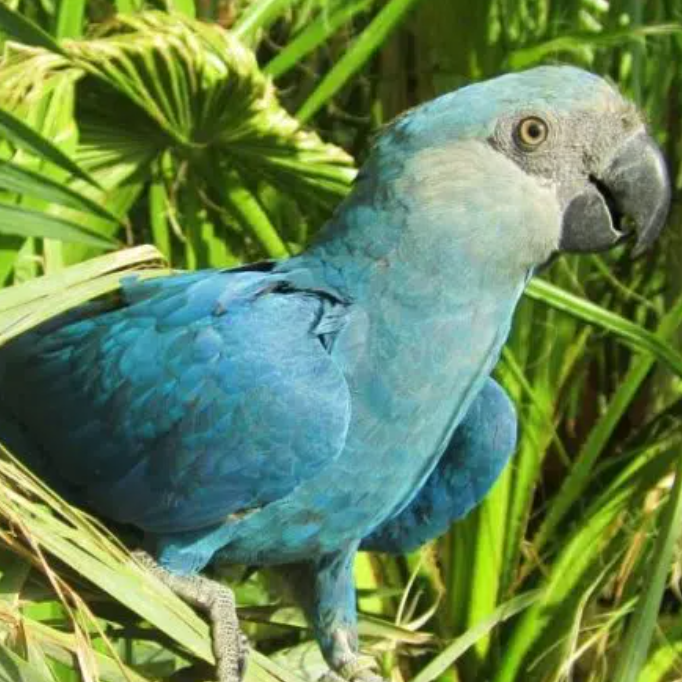
Photo Credit: https://www.birdlife.org/news/2018/09/05/spixs-macaw-heads-list-first-bird-extinctions-confirmed-this-decade/
Conservation
Spix’s macaw was declared extinct in the wild in 2000, with only birds in captivity remaining. Luckily, through breeding programs, 200 Spix’s macaws have been bred from just 2 parent birds. In 2019, 52 birds were reintroduced to their natural habitat.
One of the main challenges in conservation is the loss of their habitat. The Caatinga biome has faced deforestation over time. Without proper protection and reforestation, it would be difficult for reintroduced Spix’s macaw to survive.
Conservation Efforts
1. ACTP (Association for the Conservation of Threatened Parrots)
The ACTP runs a successful breeding program that helps in increasing captive Spix’s macaw populations.
2. ICMBio (Brazilian Institute for Biodiversity Conservation)
The ICMBio works on habitat restoration and species protection, including the Spix’s macaw in Brazil.
Conclusion
The Spix’s macaw is a symbol of hope for conservation. Even though they were once extinct in the wild, conservation efforts are giving them a second chance. With continued efforts to protect and restore their habitat, future generations may be able to witness these birds flying freely in the forests of Brazil.