
The secretary bird (Sagittarius serpentarius) is a unique and endangered bird of prey that is known for its unique name and appearance.
This bird is recognizable by its featherless red-orange face, eagle-like head and body, and black feathers on the back of its head. Secretary birds are considered tall birds, with a height of around 1.3 meters and a wingspan of 1.9 to 2.1 meters. Its body is covered in pale grey feathers, with black flight feathers.
No one knows for certain where the secretary bird gets its name, but some suggest it looks resembles secretaries from the 1800s, who wore dark knee-length pants and tucked quill pens behind their ears. Others believe the name comes from the Arabic term saqr et-tair, meaning “hawk of the semi-desert” or “hawk that flies.”
Behavior
Unlike most raptors, secretary birds are terrestrial, spending most of their time walking across grasslands in search of prey. They can cover vast distances, using their strong legs to stomp on prey. Secretary birds are known for their unique hunting method, delivering kicks to kill snakes, rodents, lizards, and insects.
Secretary birds are monogamous and form lifelong pair bonds. Their courtship displays include flying up and down while occasionally calling with guttural croaks. On the ground, they perform elaborate dances involving bowing, wing-spreading, and jumping.
Habitat
Secretary birds live in open grasslands, savannas, and lightly wooded areas across sub-Saharan Africa. They prefer habitats with short vegetation, which makes it easier to spot and catch prey. These birds can be found in countries like Senegal, Somalia, South Africa, and others throughout sub-Saharan Africa.
Breeding
Secretary birds build their nests in thorny trees, usually acacias. The parents construct large nests, sometimes up to 2.4 meters wide, using twigs, sticks, mammal fur, dung, leaves, and grasses.
Female secretary birds can lay up to three eggs, which hatch in the order they are laid, usually after around 45 days. Unlike many other birds of prey, secretary birds often successfully raise more than one chick.
During the first few weeks, a parent remains in the nest at all times to care and feed the chicks. By about 40 days, the chicks begin to eat pieces of food dropped in the nest by the parents. At six weeks old, the chicks start to resemble like miniature versions of the parents.
Diet and Threats
Secretary birds are carnivorous birds, hunting small mammals, reptiles, birds, and large insects. They are also capable of catching and killing snakes, including venomous ones.
Adult secretary birds face few natural predators other than humans, but their eggs and chicks are at risk from predatory birds such as crows, ravens, and owls.
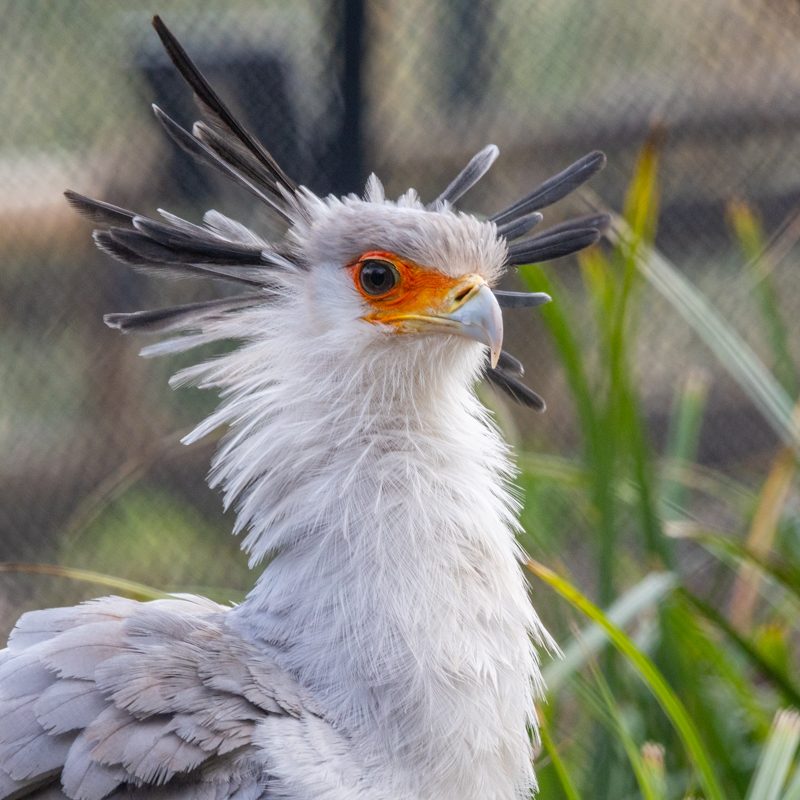
Photo Credit: https://paigntonzoo.org.uk/animals-az/secretary-bird/
Conservation
Unfortunately, the secretary bird is currently classified as “Endangered” by the IUCN. Its population is declining due to habitat loss and deforestation. Luckily, local organizations are raising awareness to help save secretary birds.
Conservation Efforts
1. BirdLife International
BirdLife International works to protect grassland habitats in Africa, ensuring that secretary birds and other species can thrive.
2. International Union for Conservation of Nature (IUCN)
The IUCN makes plans for the conservation of vulnerable species, including the secretary bird, and provides a structure for governments and organizations to join conservation efforts.
3. Wildlife Conservation Society (WCS)
Works in African regions to reduce threats like habitat loss. WCS also provides training and resources for rangers to prevent poaching and protect nesting areas.
Conclusion
The secretary bird is an iconic symbol of Africa’s grasslands, known for its unique looks and hunting techniques. However, like many other species, it faces significant challenges such as human activities and environmental changes.
By protecting its natural habitat and raising awareness, we can help ensure a better future for the secretary birds. Together, we can make a difference for the secretary bird.