
The Bali myna (Leucopsar rothschildi), locally known as Jalak Bali, is one of the most endangered birds in the world.
They are medium-sized birds, measuring approximately 25 centimeters in length and weighing around 70 to 115 grams. Bali mynas have almost fully white feathers, black wing tips and tail tips, drooping crest, yellow beak, and blue skin near their eyes. Although male and female Bali mynas are quite similar in appearance, the male has a longer crest.
The Bali myna was first formally described by science in 1912 by zoologist Erwin Stresemann. He introduced a new genus, Leucopsar, and the Bali myna remains the only species in the genus.
Behavior
Bali mynas are highly social animals, they are found in small flocks of 5 to 10 birds. Though large flocks of up to 20 birds can be found, especially during the breeding season.
Bali mynas are also monogamous animals. Once a pair forms, they generally stay together for life. They have a life span of 7 to 8 years, but captive birds can live up to 15 years.
Habitat
As expected from their name, the Bali myna is only found in Bali, Indonesia. Most of them can be found in tropical forests, particularly in dry coastal forests. They live in the holes of trees and line their nests with leaves, stems of dried plants, and even feathers.
Breeding
They breed between November and April, which is the rainy season for Bali. During their breeding season, the male attracts the female by calling loudly and bobbing up and down. Female Bali myna can lay up to 3 eggs. Both the male and female would bring food to the nest for the chicks after hatching.
Diets and Threats
Bali mynas are omnivores, so they eat insects and fruits. Although their main threats are poachers, illegal trading, and deforestation, these birds are also hunted by snakes, cats, hawks, and other birds of prey. Their eggs are at risk from lizards, rodents, and monkeys.
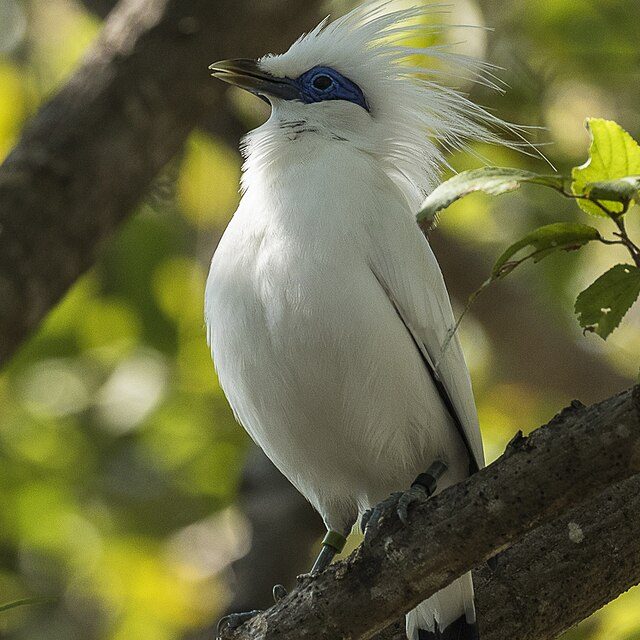
Photo Credit: https://commons.wikimedia.org/wiki/File:Bali_Starling_-_Bali_Barat_MG_8974_(29654702785).jpg
.jpg)
Conservation
The Bali mynas are a critically endangered species. There are potentially a maximum of 50 Bali mynas left in the wild.
Efforts to conserve Bali myna include captive breeding, reintroduction into the wild, and habitat restoration. Luckily, local communities have been raising awareness campaigns to reduce illegal trapping and improve conservation efforts.
Conservation Efforts
1. San Diego Zoo Wildlife Alliance
The San Diego Zoo has supported Bali myna conservation through its breeding programs and collaborations with other institutions. The zoo’s involvement ensures continued support for the species’ survival.
2. BirdLife International
BirdLife International played a significant role in raising awareness for Bali myna protection by conducting research on its population, and working with local authorities to enforce laws and manage protected areas.
3. Bali Starling Project (Bali Myna Conservation Program)
This project, based in Bali Barat National Park, focuses on breeding, reintroducing, and monitoring Bali mynas in the wild, and has successfully restored populations to their native habitat.
Conclusion
The Bali myna is a symbol of the importance of wildlife conservation. Despite facing challenges from illegal trade and habitat loss, significant efforts have been made in protecting this species through breeding programs, reintroduction efforts, and community engagement.
As communities continue to raise awareness and support conservation efforts, there is hope for a brighter future for the Bali myna. Preserving this iconic bird is not only essential for biodiversity but also a reminder of the collective responsibility to protect the natural world around us.
Hi, this is a comment.
To get started with moderating, editing, and deleting comments, please visit the Comments screen in the dashboard.
Commenter avatars come from Gravatar.