
The California condors (Gymnogyps californianus) are the largest wild birds in North America.
With an overall length ranging from 109 to 140 cm and wingspan from 2.49 to 3 m, the California condor has the largest wingspan of all birds in North America. Unlike most birds of prey, the female is smaller than the male. Their weight can range from 7 to 14.1 kg.
The California condor is covered with black feathers except for its bald head. There is a large triangular patch or bands of white feathers on the underside of its wings. The skin colour on their head varies from yellowish to a glowing reddish-orange. The juveniles’ heads are darker and get brighter with age. The patches under their wings are a soft grey instead of the white feathers adults have.
Behaviour
The California condors aren’t really considered a bird of prey, in a traditional sense. However, most scientists believe that California condors are a part of the birds of prey.
Birds of prey are predators, they hunt and they kill. They have strong talons and beaks. But the California condors don’t hunt, they scavenge, they don’t hunt animals, and they don’t have strong talons.
The California condors are highly social animals and may often feed together. They have a clear social structure, especially in big groups. They use body language, playful sparring, and a mix of hisses and grunts. This social hierarchy shows up most when they’re feeding, the more dominant birds usually get to eat first, while the younger ones wait their turn.
California condors perform urohidrosis, or defecate on their legs, to reduce their body temperature. They also have a long lifespan and can reach 60 years old.
Habitat
During the ice age, California condors used to soar over parts of eastern, western, and southern North America along coastlines and in forests, mountain canyons, grasslands, and deserts.
Today, the wild California condors can only be found in parts of California, Arizona, Utah, and Baja California, Mexico.
The California condor makes its home in places like rocky hillsides, pine forests, and oak-covered grasslands. They usually nest on cliffs or in tall trees. Each bird covers a lot of ground and can fly as far as 250 km to look for carcasses.
Breeding
California condors typically form long-term mates, but not always. Males try to impress females by putting on a display. They would puff out their neck feathers, turn their heads a bright red, spread their wings, and slowly approach. If the female lowers her head, it means she accepts.
They build their nest in caves or cliff ledges, and they pick spots with nearby trees and open space for easy takeoff and landing.
The female would produce 1 egg every breeding season, but if the egg is lost or removed, the female would produce another egg. This process is called a “double clutch”, other birds that “double clutch include bald eagles and cockatiels. Eggs are laid as early as January to as late as April.
The egg weighs around 280 grams and measures from 90 to 120 mm in length and around 67 mm in width. The eggs hatch after 53 to 60 days, and the egg is incubated by both parents. The chicks are born with their eyes open and can sometimes take weeks to come out of their eggshell.
The chicks would fledge after 5-6 months, but they would still depend on their parents for about another year.
Diets and Threats
California condors are generally considered carnivores, but they don’t hunt and eat live prey. Instead, they eat carcasses, and they prefer fresh kills over decayed carcasses.
The California condors have existed during the ice age, and it is likely that they scavenged megafauna such as the ground sloth and mastodons. They prefer to eat the carcasses of large mammals such as sheep, goats, cattle, pigs, bears, and more. They may also eat small animal carcasses, such as rabbits, squirrels, coyotes, and more.
Additionally, California condors may eat chips of bone from small animals such as ground squirrels to supplement their calcium needs. If a parent of a California condor chick brings pieces of metal, glass, or plastic to their nest, chicks may accidentally consume them. Though this may not be the main cause of their death, it can still affect their population and conservation.
There is no known predator for the California condor except humans, but the eggs may be eaten by ravens, and the chicks/juveniles can be killed by golden eagles or bears.
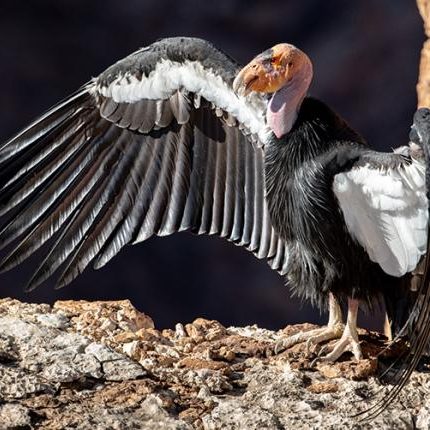
Photo Credit: https://peregrinefund.org/explore-raptors-species/vultures/california-condor
Conservation
In 1987, there were only 22 surviving California condors, and all 22 of them were captured for the California Condor Recovery Plan. Their captive breeding program got off to a slow start due to their mating habits. But by utilizing their “double clutch”, researchers can take care of the first egg using a puppet while the parents take care of the other.
Another challenge that they faced, and are still facing, is the main cause of death of lead poisoning. Lead poisoning is a big cause of death for scavengers, including the California condor. The lead poisoning enters their body from the carcasses they consume. These carcasses contain lead poisoning from ammunition.
Conservationists have raised awareness to stop using lead ammunition while hunting. There is also a law that requires hunters to use non-lead ammunition while hunting near the California condors’ range.
Conservation Efforts
1. Peregrine Fund
The Peregrine Fund breeds and releases California condors. They also monitor the birds and treat them for lead poisoning. To prevent this, they work with hunters to raise awareness and promote non-lead ammunition.
2. U.S. Fish and Wildlife Service
The U.S. Fish and Wildlife Service played a significant role in saving the California condors by establishing the California Condor Recovery Program in 1979. In the 1980s, when there were only 22 left, they brought all the birds into captivity to start a breeding program.
Conclusion
The California condor is still recovering, but it’s come a long way. From the brink of extinction to over 300 birds flying free again. The journey ahead is still challenging, lead poisoning and trash are a big problem, but conservationists and local communities are working hard to help save this species.
If we keep protecting their habitat, clean up their food sources, and raise awareness, these birds have a good chance of living for many years to come.