
The Northern Bald Ibis (Geronticus eremita), also known as Waldrapp or hermit ibis, is one of the world’s rarest ibis.
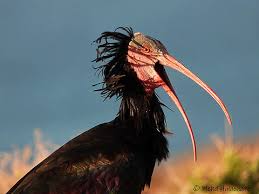
They are considered medium-sized birds with a height of 70-80 cm and an average weight of 1-1,3 kg. They have black feathers with iridescent violet and greenish-bronze, and a puffed-up crest on the back of their neck. The heads of adults are bald and wrinkled, while the heads of the juveniles are feathered. Both their beaks and legs are red, and their beaks are long and slightly curved.
Both male and female Northern bald ibis are similar, but the males are larger and have longer bills. Males with longer bills are usually more successful in attracting a mate.
The Moroccan Northern bald ibis has longer bills than their Turkish counterpart. For the males, the Moroccan Northern bald ibis has an average bill length of 141.1 mm, while the Turkish Northern bald ibis has an average bill length of 129.0 mm. The female Moroccan Northern bald ibis’ bills are also longer than their Turkish counterpart, with an average of 133.5 mm, while the Turkish Northern bald ibis has an average of 123.6 mm.
The genus name, Geronticus, derives from the Ancient Greek word γέρων, which means old man and refers to the adults’ bald and wrinkled heads. Their species name, eremita, is also derived from an Ancient Greek word, ἐρημία, which means desert and refers to their habitat.
Behaviour
The Northern Bald Ibis is a colonial and migratory bird, which means this bird lives in groups and migrates seasonally between breeding and wintering grounds. In addition to living in groups while migrating, they would also flock together to their destination.
Northern Bald Ibises communicate with each other using different forms of croop, which is a call used by the bird that earned its name from sounding like a rough cough. Within each community, these birds hold a generational hierarchy, where older birds tend to lead the flock over younger birds.
Habitat
The Northern Bald Ibis nests on quiet cliff ledges and searches for food in dry, open areas like grasslands, rocky plains, and unused farmland. Their nesting cliffs need to be close to good feeding areas, so the birds don’t have to travel far to find food. They can be found in barren, semi-desert, or rocky habitats, usually close to running water.
The natural habitat of the Northern bald ibis has shrunk a lot over the years, now they can only be found in Morocco, Turkey, and Syria. But reintroduction projects have started to reintroduce the Northern bald ibis back to Europe. Historically, they had a much wider range, they were once found spread all over the Middle East, northern Africa, and southern and central Europe.
Most of the entire wild Northern bald ibis population can be found in Morocco, with just over 500 birds found in the Souss-Massa National Park, where there is a single colony that makes up almost half of the entire wild Northern bald ibis population.
Breeding
The Northern bald ibises are monogamous birds. The male would clean a nest site and prepare materials for the nest. Since they nest at cliff ledges, volunteer climbers have created extra ledge spaces in the Souss-Massa colonies. In Birecik, they made artificial nest boxes to ensure space for the birds to create nests. The nests are made of twigs, grasses, and straw.
After preparing the nest site and materials, the male ibis would use it to attract female ibis. The male would wave his crest and do low rumbling calls to attract a female. Once the birds have paired, they would perform a courtship display by bowing and preening each other’s feathers.
Northern bald ibises lay 2-4 eggs every breeding season, with each egg weighing an average of 50.16 g. The color of the eggs is initially bluish-white with brown spots, but they get darker during incubation. The eggs are incubated for 24-25 days, and both parents incubate the eggs. The chicks would start to fledge after 40-50 more days, and their first flight takes place at around two months.
Diets and Threats
Northern bald ibis are carnivores, and they consume a variety of foods. Their diet consists mainly of lizards and darkling beetles. Sometimes they may also take animals such as birds, small mammals, and small invertebrates. They would also feed on vegetation, including berries, shoots, duckweed, and rhizomes of aquatic plants.
Adult Northern bald ibis may be killed by falcons, but the chicks are in danger of being attacked by common ravens and Egyptian vultures. In Souss-Massa National Park, one of the main causes of breeding failure is the loss of eggs due to predators.
Conservation
Unfortunately, the Northern bald ibis is considered “Endangered” by the IUCN. As the species is nearing extinction, it is listed in Appendix 1 of CITES, which means commercial trade of this species is prohibited. Fortunately, the population trend of this species is stable, as stated on the IUCN Red List website.
Throughout the 1900s until 2002, their population decreased by 98% due to many factors, mainly from human activities such as hunting, infrastructure development near breeding cliffs, and pesticide poisoning. While in the Souss-Massa National Park, the main cause of breeding failure is loss of eggs to predators, especially the common raven.
Conservation Efforts
The LIFE20 project is an EU-funded project to continue the previous LIFE+12 project, which aims to reintroduce the Northern Bald Ibis in the Alps. This project started in 2022 and will continue to run until 2028. This project would include collaboration by 10 partners through 4 countries, which include Austria, Germany, Italy, and Switzerland. Other than that, the LIFE20 will be guided by Zoo Vienna with the participation of the Waldrappteam.
The LIFE20 project focuses on 4 main actions, which are the following:
1. Establishment of a self-sustaining population
This project aims to create a self-sustaining population of the Northern Bald Ibis that is capable of surviving without intensive human care by establishing new breeding colonies. By the end of the project, more than 260 Northern Bald Ibises are expected to migrate between the northern foothills of the Alps and Tuscany. The primary action taken to establish new breeding colonies is through Human-Led Migration (HLM).
Human-Led-Migration is a method of restoring migratory routes of birds bred by humans for their reintroduction into the wild. This technique is done to restore migratory routes caused by reduced population. Juveniles would be imprinted on their adoptive parents, who they follow, then the juveniles would be adapted to the aircraft that would be used. The juveniles accompany their adoptive parents by flying to their wintering grounds.
2. Actions against illegal poaching
Illegal poaching has been a main cause of the decreasing population of the Northern Bald Ibis, especially in Italy. Most of the Northern Bald Ibises in the European population have GPS tags. This monitoring has enabled efficient measures against illegal poaching in Italy in the previous LIFE+12 project and will be continued in the current project. Hopefully, by the end of this project, losses caused by illegal poaching in Italy will decrease from the current 31% to less than 25%.
Extensive actions to reduce illegal poaching with partner organizations, policymakers, and hunting associations at national and European levels. Other than that, attempts to raise public awareness through public relations and media work have been made and remain an important part of achieving this goal.
3. Action against electric shock
Northern Bald Ibises, similar to other birds, prefer to use the exposed masts of middle-current pylons as places to rest and sleep. On unsecured poles, these birds may cause a short circuit. Unfortunately, electrocution has been a main cause of death in Austrian breeding grounds. In Austria, electrocution losses are to be reduced from the current 45% to less than 38% by the end of the project. This target is to be achieved with the collaboration of multiple power companies of Upper Austria (NetzOÖ), Salzburg (LSB), and Carinthia (KNG) to secure around 160 high-risk pylons near the breeding areas.
Other than that, a legal regulation for re-securing medium-voltage pylons should be given, as it has been proven to reduce Northern Bald Ibis deaths. In Germany, this measure has already been taken, as a result of the nationwide implementations, Northern Bald Ibises have not been killed by electrocution in Germany for years. However, it is still a common cause in Austria. The project team has received support from legal and policy experts at WWF Germany for a long-term implementation. By securing these pylons, not only are Northern Bald Ibises protected, but also other birds too, showing this effort not only protects one species from danger
4. Public Relations
Most of the Northern Bald Ibis population is tagged with a solar-powered GPS to map out their location. Information from the tag is mainly used for monitoring, but is also used to be able to carry out measures in the event of injuries.
The data is also transferred to the Movebank online database, where it is used for research purposes. From Movebank, the data is transferred to the free Animal Tracker app, where it is made available to the public. The app shows the bird’s position clearly and understandably.
Conclusion
The Northern Bald Ibis is an unusual and unforgettable bird. After nearly disappearing, it’s now slowly making a comeback, thanks to people who care and work across multiple countries to help save it. Its story shows how even a strange-looking bird that’s been forgotten for centuries can still get a second chance.